







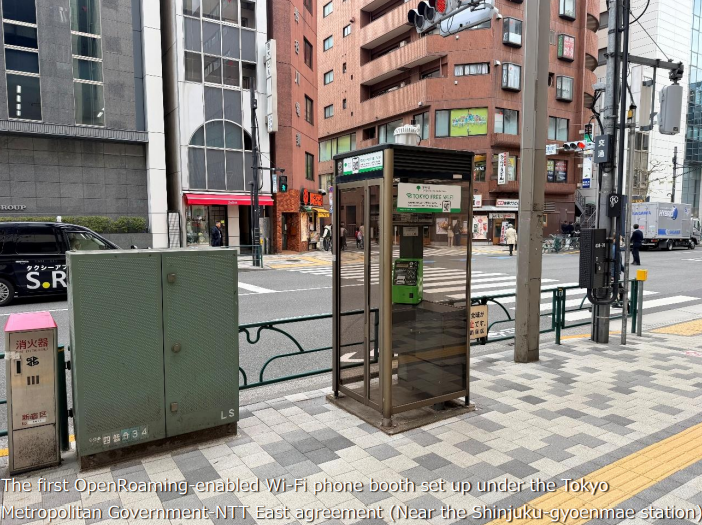
Some of the public telephone booths in Tokyo have been transformed into free Wi-Fi hotspots in the past decade to ensure a means of communication mainly in times of disaster and for inbound tourism. Such a switchover has been seen in urban centers around the world.
While their number continues to dwindle, some of the booths are now beginning to link up with OpenRoaming, an innovative platform that enables seamless, secure and automatic Wi-Fi access worldwide. With this upgrade, Tokyo aims to step up its effort to establish itself as a megacity that is “connected” and “smart.”
About 1,500 public phone booths in the Japanese capital will be retrofitted in three years to provide free OpenRoaming-enabled Wi-Fi. This service, promoted by the Wireless Broadband Alliance (WBA), allows registered users to connect automatically and securely to more than 3.5 million participating hotspots worldwide without re-registering.
A ‘Crucial Lifeline’ for Foreign Tourists
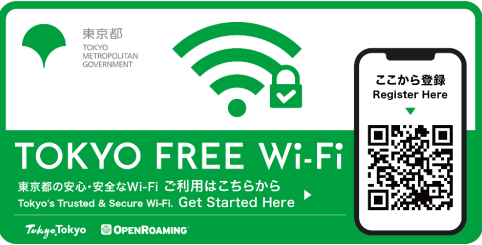
Facilities offering the TMG public Wi-Fi display this information sticker on-site
“Securing communications is a top priority in times of disaster. It will also provide a crucial lifeline for inbound tourists,” Tokyo Governor Koike Yuriko says. The Tokyo Metropolitan Government (TMG) is using the new Wi-Fi connection to accommodate the record influx of foreign visitors, who may include an emerging breed of “digital nomad” remote workers, as well as reduce communication overload in times of disasters—which are increasingly frequent and severe .
In earthquake-prone Japan, public telephones are classified as a “universal service,” and the telecommunications law requires that their availability be maintained at a certain level. This is because it is essential to ensure communication access—especially during emergencies when mobile/cellular networks may be disrupted or power outages occur.
The number of public pay phones in Tokyo, owned by Japanese telecom giant Nippon Telegraph and Telephone East Corporation (NTT East), totaled 10,525 as of March 2025, including non-enclosed pay phones.
Propping Up a ‘Connected Tokyo’

“Active use of the system—not only in times of disaster but also on a day-to-day basis—will move our efforts forward to create a ‘Connected Tokyo,’” Governor Koike Yuriko said. Her comment was made in late August when the TMG and NTT East signed an agreement on retrofitting about 1,500 NTT East-owned phone booths with OpenRoaming-enabled Wi-Fi and publicizing them.
Under the agreement, the project has started initially in areas around major stations on the Yamanote Loop Line in central Tokyo, in public parks designated as emergency shelters or other service facilities, and on some of the remote Pacific islands stretching south from the capital city.
OpenRoaming enables users to automatically and securely connect to participating public Wi-Fi hotspots and telecom networks worldwide once they sign in with a single trusted provider and obtain an identity. It also enhances security with encrypted authentication.
These features may resolve worries among Tokyo residents about Wi-Fi access. In a survey for the fiscal year to March 2025 by the Tokyo Metropolitan Government on the use of a public Wi-Fi network, 49.9 percent of respondents said they were concerned about “information leakage” while 27.3 percent pointed out, “It takes time and effort to use it.”
“It‘s upcycling, I would say,” German tourist Marius Hurlbrink commented about an OpenRoaming Wi-Fi phone booth in front of a station on the Loop Line on a recent weekend. The 34-year-old landscape architect from Hannover said there is no similar setup in his country. Showing pictures of German public phone booths on his smartphone, he said: “They are almost gone.”
The glassed-in booth bore a white-and-green sticker reading in English: “OpenRoaming TOKYO FREE W-Fi.” In the hill and valley area, there was a stream of international tourists heading into the popular temple town of Yanaka. Many of them were browsing smartphones, apparently checking directions.
How About the ‘Best Workcation’ in a Smart City
The phone booth evolution may benefit “digital nomads,” who trot the globe freely and work remotely using online technologies. Global travel magazines estimate the number at more than 50 million worldwide, including programmers, content creators, designers and developers, all of whom are likely to be perpetual travelers.
In April 2024, Japan joined the growing number of countries to issue digital nomad visas. The Japanese permit grants high-earning remote workers and their dependents a stay of up to six months.
It is quite timely that Tokyo has been named by the Swiss-based International Workplace Group (IWG) as the world’s best city for “workcation (working vacation)” in 2025. IWG, known as the world’s leading provider of flexible workspaces, cites Tokyo for its “exceptional” broadband speed, world-class transport infrastructure, high safety levels and rich cultural offerings, as well as “an exciting urban atmosphere alongside natural escapes,” on top of the newly introduced digital nomad visa.
The metropolitan government has been aiming to build a “smart Tokyo” where residents can lead high-quality lives through digital technology. For that purpose, it has been utilizing various kinds of communications means, including 4G/5G, Wi-Fi and satellite communications—by assigning the right resource for the right task—and making diverse approaches in order to build at an early date a “Connected Tokyo” , ensuring connectivity anytime, anywhere, for anyone, under any situation.
By March 2025, OpenRoaming enabled Wi-Fi had been already installed at 1,034 public places across Tokyo—859 metropolitan government-owned facilities, such as government buildings, parks and museums , as well as 175 municipal facilities run by special administrative wards, cities and other municipalities.
With the projected 1,500 OpenRoaming public phone booths as well as metropolitan-owned facilities, the number is planned to expand more than three-fold to about 3,600 by March 2028.
Wi-Fi Phone Booths: How They All Started
In 2015, the metropolitan government started providing free Wi-Fi from public telephone booths with the aim of spreading public information, enhancing convenience for foreign visitors and backing up communications in times of natural disasters.
In the run-up to the Tokyo Olympics and Paralympics in 2021, backup power equipment was attached to about 450 Wi-Fi phone booths to prepare for power outages.
The transition was in line with a global trend to convert increasingly idled phone booths into Wi-Fi hotspots to serve mobile/cell phones.
Way back in 2003, UK telecom giant BT installed Wi-Fi hotspots in about 200 of its famous red telephone boxes in Britain. In 2014, Australia’s Telstra started installing Wi-Fi hotspots into existing public phone booths in major cities including Sydney, Melbourne and Brisbane.
New York City started turning payphones into “LinkNYC” kiosks in 2015 to offer superfast Wi-Fi, recharging devices and other services. Then in 2017, BT launched its own Link kiosks (later rebranded Street Hubs), replacing outdated phone boxes.
South Africa, China, New Zealand and Spain are among other countries that have transformed phone booths into Wi-Fi hotspots.
It is ‘Super Positive’
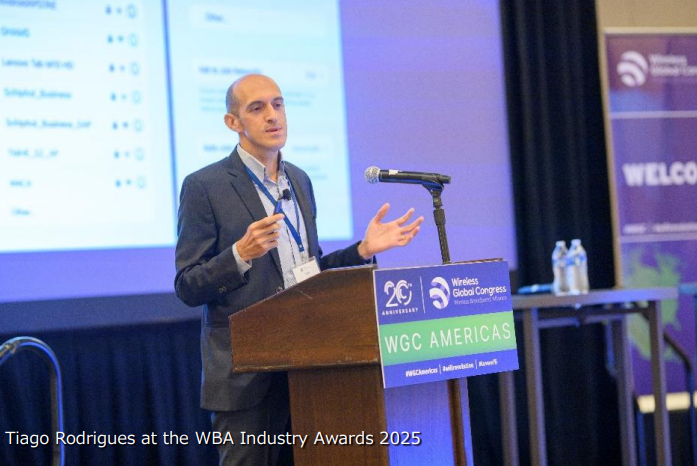
“It’s a super innovative initiative,” said Tiago Rodrigues, CEO of the Wireless Broadband Alliance (WBA), which promotes OpenRoaming, describing Tokyo’s new free Wi-Fi phone booths. He also compared them on par with the similar links in London and New York City.
“It helps with the digital inclusion either for visitors or citizens or even underserved communities,” Rodrigues, a former Portugal Telecom Group official, told the Tokyo Metropolitan Government (TMG) online magazine Tokyo Updates. He said phone booths may be rarely used today, “but if you put a different type of connectivity up, they will become more useful and that is super positive.”
He noted the TMG could use OpenRoaming enabled Wi-Fi connectivity for services in “public safety emergency situations” such as storms and other natural disasters that occur regularly, and that the WBA is “more than happy” to test those services.
One of his ideas is to send alerts to anyone that is connected to OpenRoaming-enabled Wi-Fi. “The message can say things as ‘please be aware of a rain coming, or a strong wind coming, or whatever event coming,’” he said. “Those types of messages I think are very quick wins that can be explored.”