





93.7% of participants express willingness to continue using the recycling program
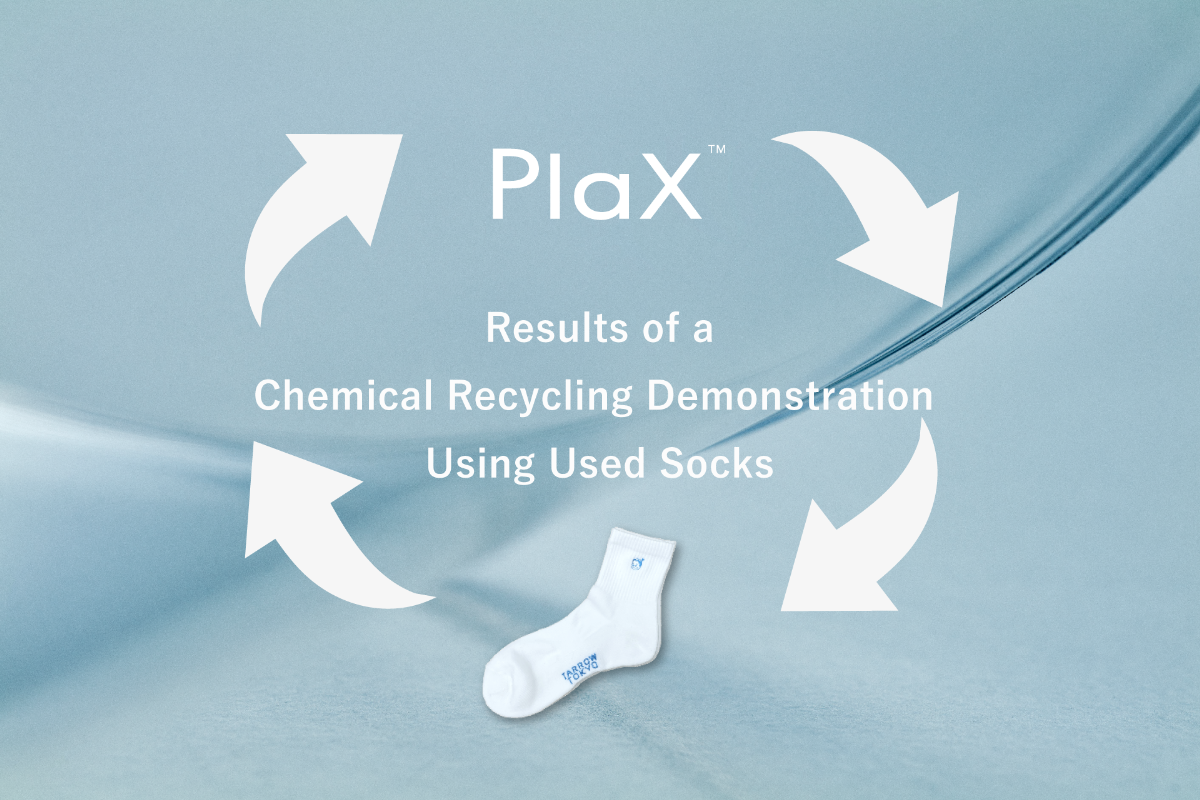
Kyoto, Japan – Bioworks Inc. (Headquarters: Soraku-gun, Kyoto Prefecture; President & CEO: Koji Sakamoto; hereinafter “Bioworks”) has conducted a pilot collection and recycling demonstration using worn socks made with its next-generation synthetic fiber PlaX, proving the feasibility of chemical recycling and advancing real-world implementation of a circular business model.
This project was carried out with support from the Tokyo Metropolitan Government’s “Tokyo Co-inNovators” startup support program, which promotes proof-of-concept initiatives addressing social challenges.
This press release reports the results of the recycling demonstration as well as findings from a participant survey conducted as part of the project.
Background
Globally, less than 1% of textile materials are recycled from fiber to fiber, highlighting significant challenges in achieving circularity for apparel, which is often made from blended materials.
(Source: Ellen MacArthur Foundation, A New Textiles Economy: Redesigning Fashion’s Future)
According to Japan’s Ministry of the Environment, consumable apparel items such as underwear and socks are among the most frequently purchased—and most frequently discarded—clothing categories within a single year.
(Source: https://www.env.go.jp/policy/pdf/st_fashion_and_environment_r2matome.pdf)
Bioworks’ own research further shows that only around 10% of socks, underwear, and innerwear are reused or recycled, while approximately 90% are discarded. (Source: Bioworks Inc., Survey on Reuse and Recycling Trends and Consumer Awareness for Socks, Underwear, and Innerwear. )
This contrasts with apparel overall in Japan, where 34% is reused or recycled and 66% is discarded. (Source: https://www.env.go.jp/policy/sustainable_fashion/goodpractice/case26.pdf)
These findings indicate that socks and similar consumable items are less likely to be reused and more likely to be disposed of compared to other garments.
Given their short product lifespan and limited circulation, socks were selected as the focus of this project. Bioworks hypothesized that designing products for recyclability could significantly improve circularity, making socks an ideal test case.
Overview of the Demonstration Project
The project was conducted in collaboration with Gluck Japan Co., Ltd. (Headquarters: Nagoya, Aichi Prefecture; President: Yasuyuki Yui), operator of the brand TARROW TOKYO, along with two commercial facilities in Tokyo.
Socks incorporating PlaX fiber were distributed to consumers and businesses. After a defined usage period, the socks were collected and subjected to a chemical recycling process. The project evaluated technical feasibility, cost, environmental impact, and user experience to assess the viability of a new circular business model.


Results of the Recycling Demonstration
The project examined whether used socks with dirt and odor could be chemically recycled back into polylactic acid (PLA), the original raw material. The scope of this demonstration focused on monomer recovery, not final product manufacturing.
Chemical recycling was validated step-by-step from laboratory scale to pilot scale. After optimizing conditions at the lab level, pilot-scale testing confirmed that high-purity, high-quality recycled monomers could be obtained at all stages.
PLA resin produced from these recycled monomers demonstrated performance equivalent to virgin PLA, proving its suitability for reuse.
However, challenges were identified in terms of material yield during separation processes and cost efficiency for commercialization. To address these issues, Bioworks will continue to promote higher PlaX content in products, expand PlaX distribution, and pursue further process improvements.
Life Cycle Assessment (LCA) Findings
Based on estimated manufacturing conditions:
1) Socks made with recycled materials are expected to achieve approximately 9% CO₂ emissions reduction compared to socks made with virgin materials
2) During yarn production, recycled PlaX staple fibers showed approximately 80% lower CO₂ emissions compared to conventional PlaX fibers
Optimizing product design—including PlaX content—is expected to yield even greater environmental benefits.


Participant Survey Results
The project addressed assumed psychological barriers to recycling, such as inconvenience, discomfort, privacy concerns, and reluctance to reuse items worn by others. Following sock collection, a survey was conducted among participants.
Key findings include:
1) 70.8% reported feeling no anxiety or discomfort recycling used socks with dirt or odor
2) 70.8% stated that the collection process required little or no effort
These results are attributed to the following design features:
1) PLA-based opaque collection bags, reducing privacy concerns
2)Simple drop-off or mailing process, requiring only mailbox posting or box deposit
Furthermore, 93.7% of participants answered that they would “definitely use” or “use if available” similar recycling systems in the future.
Regarding purchase intent for products made from collected socks:
1) 87.5% indicated willingness to purchase if priced the same as or lower than conventional products
However, when expanding collection items to innerwear or underwear, participation willingness declined. Notably, 29.2% expressed reluctance to participate for underwear recycling, highlighting greater psychological resistance compared to socks.

Furthermore, a total of 93.7% of participants responded that they would “definitely use” or “use if available” a similar recycling system in the future, indicating a high level of willingness to participate in reuse and recycling initiatives.

Regarding purchase intent for products made from collected socks, a combined 87.5% of respondents stated that they would be willing to purchase such products if priced at the same level as, or lower than, conventional products. This indicates that aligning costs with market expectations could significantly increase consumer acceptance of recycled products.
By contrast, willingness to participate declined when the scope of collection was expanded to include innerwear or underwear. 29.2% of respondents reported reluctance to participate in underwear collection, revealing a substantially higher psychological barrier compared with socks.

Based on insights gained from this demonstration regarding consumer behavior and psychological barriers, Bioworks will continue to collaborate with partner companies to develop a sustainable recycling model that encompasses the entire process—from collection to material regeneration.
About PlaX
PlaX is a plant-based synthetic fiber modified from PLA through Bioworks technology, engineered to deliver enhanced quality and performance while significantly reducing environmental impact. Developed from renewable resources such as sugarcane, it represents a next-generation alternative to petroleum-based fibers like polyester and is drawing global attention for its versatility and sustainability.
Key Features of PlaX fiber
1) Reduces CO₂ emissions by approximately 70% in filament production and 50% in staple fiber production compared with polyester.
2) Uses about 92% less water from raw material processing to yarn production compared with cotton.
3) Biodegrades into water and CO₂ under industrial composting conditions.
4) Compatible with chemical recycling processes that regenerate equivalent materials from waste; related research and development is in progress.
5) Reduces CO₂ emissions during thermal disposal and generates no dioxins.
6) Shows antibacterial effects derived from lactic acid, inhibiting the growth of Moraxella bacteria and Staphylococcus aureus.
About Bioworks Corporation
Bioworks Corporation is a material creation company envisioning a new ecosystem where the joy of making and the richness of wearing can coexist sustainably. Founded in 2015, Bioworks develops and markets PlaX, a plant-based synthetic fiber modified from PLA by Bioworks technology. By replacing petroleum-derived materials and advancing circular resource use, Bioworks strives to help build a circular society and a more sustainable environment—starting from the material itself.
Company Information
CEO: Koji Sakamoto
Head Office: 1-7 Hikaridai, Seika-cho, Soraku-gun, Kyoto (Keihanna Plaza Laboratory Building 7F)
Established: 2015
Business: Development, manufacturing, and sales of modified polylactic acid compounds (PlaX) and related products; initiatives promoting circular resource utilization
Official Website: https://bioworks.co.jp/en/
Official Online Store: https://bio-plax.com/