

For days leading up to a blue moon, Tokyo’s iconic twin-towered city hall and its neighboring green public park glittered and glowed after dark. They came alive with sounds and rhythms on one side of Shinjuku, a bustling urban center.
An international projection mapping competition was staged on the 127-meter (417-foot)-tall façade of the main Tokyo Metropolitan Government building. Just across the street, a dozen illuminated art installations were set up outdoors, many of which offered immersive and interactive experiences. GAIA, a giant model of planet Earth, floated overhead shining and rotating.
All told, about 80,000 visitors from home and abroad came to the event titled TOKYO LIGHTS 2026 from May 23 to 31, according to its organizers. The venue was located on Shinjuku’s west side, which bristles with high-rise business buildings.
Website: TOKYO LIGHTS 2026
[Promoting Tokyo’s ‘Nighttime Tourism’]
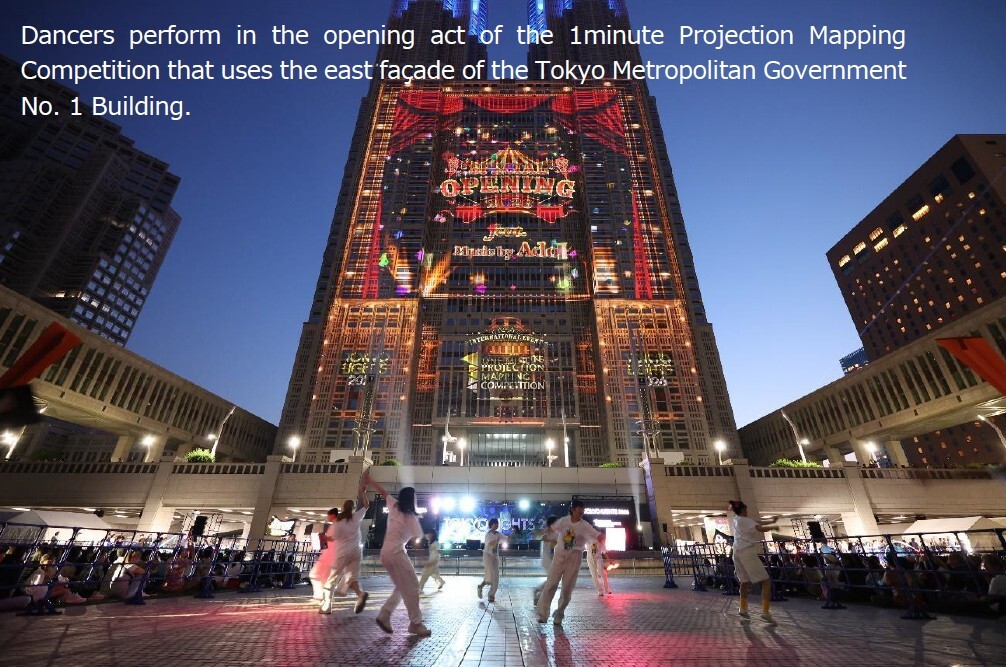
“We have showcased the potential of Tokyo’s new nighttime tourism to the world,” the event’s public relations office said in a wrap-up press release. TOKYO LIGHTS 2026, co-organized by the Tokyo Metropolitan Government (TMG), combined the “1minute Projection Mapping Competition” using the exterior of the TMG No. 1 Building and the “Light Art Park” exhibition on the grounds of Shinjuku Chuo Park.
Tokyo Governor Koike Yuriko said that Tokyo has reached second spot in the closely followed world city ranking, “Global Power City Index.”
“Nightlife options were cited as a key factor in that rise,” she told the projection mapping award ceremony on May 30—on the eve of the rare second full moon in a month (blue moon). The ceremony was held at the semi-circular TMG Citizens’ Plaza, the designated viewing spot for the competition on the building façade.
For more than two years, a nightly projection mapping show has been hosted at the TMG No.1 Building, using its façade as a canvas.
From its 33rd floor and upward, the 48-story structure splits into two towers leaving a rectangular space below—127 meters high and 110 meters wide. The vertical area of about 14,000 square meters serves as the projection screen.
“We have welcomed approximately 1.4 million visitors so far,” she said. Guinness World Records™ has recognized the program, dubbed TOKYO Night & Light, as the “largest architectural projection-mapped display (permanent).”
[‘My Best Possible Award’: GRAND PRIZE Winner]
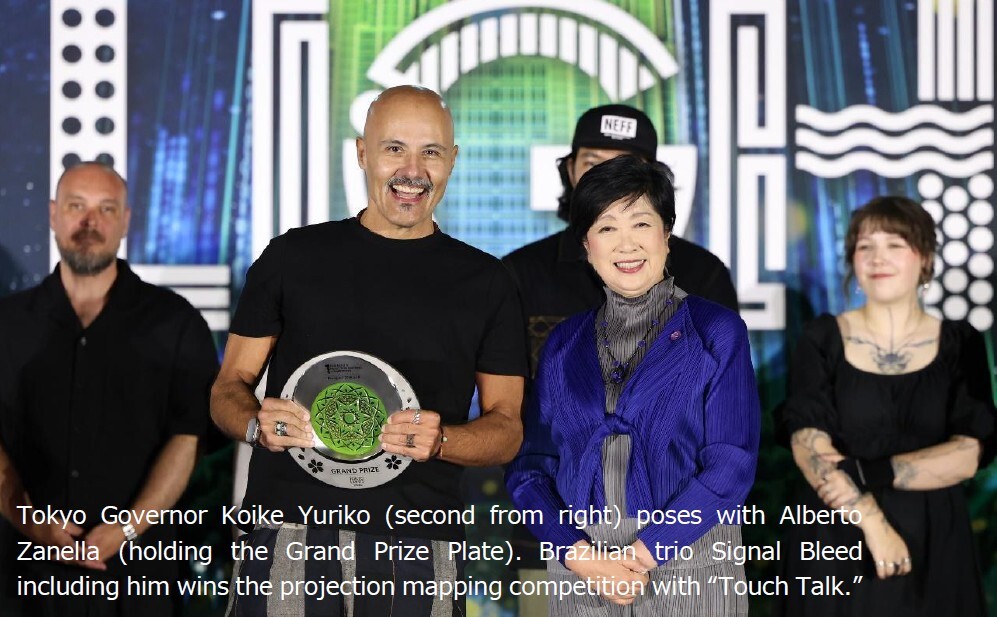
The GRAND PRIZE of the 1minute Projection Mapping Competition went to “Touch Talk” created by Brazilian group Signal Bleed. This unit consists of Alberto Zanella, Samuel Simionato and another artist who goes by the pseudonym Fesq. They received 2 million yen (about 125,000 dollars) in prize money.
“I don’t have many awards. This is my best possible one. So, I’m very honored,” Zanella said in English, calling the event “certainly one of the best in the world.” The unit has collaborated for six years on corporate projects.
Zanella also personally presented his solo work “Lighthouse” at Expo 2025 Osaka in Japan last year. He is preparing another solo work—mapped visual content for LED panels at Rock in Rio 2026, a premier global music festival, to be held in Rio de Janeiro this September.
Widely recognized as one of the world’s most prestigious and oldest projection mapping competitions, this contest drew 412 submissions from 65 countries and regions. Of them, 18 had been selected as finalists and were screened on the four weekend nights of May 23, 24, 30 and 31. The duration of entries was limited to 60-119 seconds.
[Diverse ‘Dialogues’ in Projection Mapping]
Based on the given theme of “Dialogue,” the 18 finalist works abound with a variety of concrete and abstract images and patterns. Human eyes, heads, faces, hands, flowers, plants, trees and other living subjects as well as buildings and other inanimate objects pop up, vanish, expand and shrink amid fast-changing abstract visuals.
In the “Touch Talk” visuals, two hands force open a central vertical door. To suspenseful music, several silhouetted humans bang their palms against the screen as if from inside. Two facing hands stretch their index fingers to touch each other’s tip. Then, in cascading green rays, a plant grows into an exuberant tree to end the projection lasting about 100 seconds with a hopeful conclusion.
“What if two voices, reaching across the divide, simply couldn’t hear each other? A dialogue that begins with curiosity and fractures into noise. Forces reach from either side,” the “Touch Talk” concept statement says. “Something unexpected grows rooted in truly listening. Connection was always one touch away.”
The event’s SECOND PRIZE was won by Spanish artists unit VPM with “Aporia” and the THIRD PRIZE by Thai group Bigcool with “The Beauty of Collision.” A special award, the Tokyo Tokyo PRIZE, went to “1Pulse” created by Romania’s Anionavision. Japanese artist Narahara Taro took the Audience Prize with his work “Infinite Dialogue.”
“As the world becomes increasingly diverse, our differences are becoming more and more apparent,” Ishita Michiyuki, the competition’s Executive Producer and Chief Juror, told the ceremony. “By acknowledging these differences and working together to find common ground, we can forge new paths and create the future,” he added, explaining the purpose of the theme.
He noted the finalist works seemed to have prompted diverse kinds of dialogues—buildings vs. videos, viewers vs. videos, viewers vs. themselves, and humans vs. robots or machines.
Official website: 1minute Projection Mapping Competition
1minute-pm.com/en/news/260709/
YouTube: 1minute Projection Mapping Competition closing ceremony
https://www.youtube.com/watch?v=CP97AChkGKU
[GAIA: Watching the Earth ‘as if from Space’]
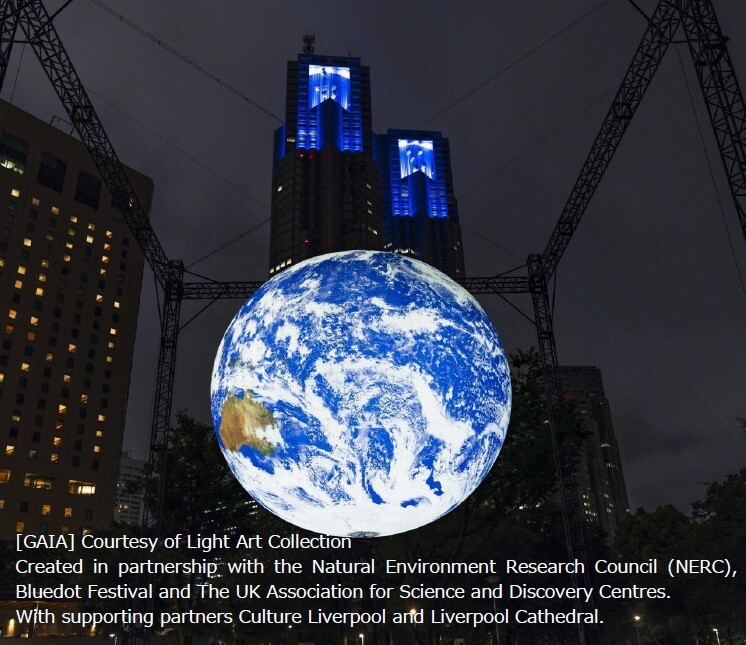
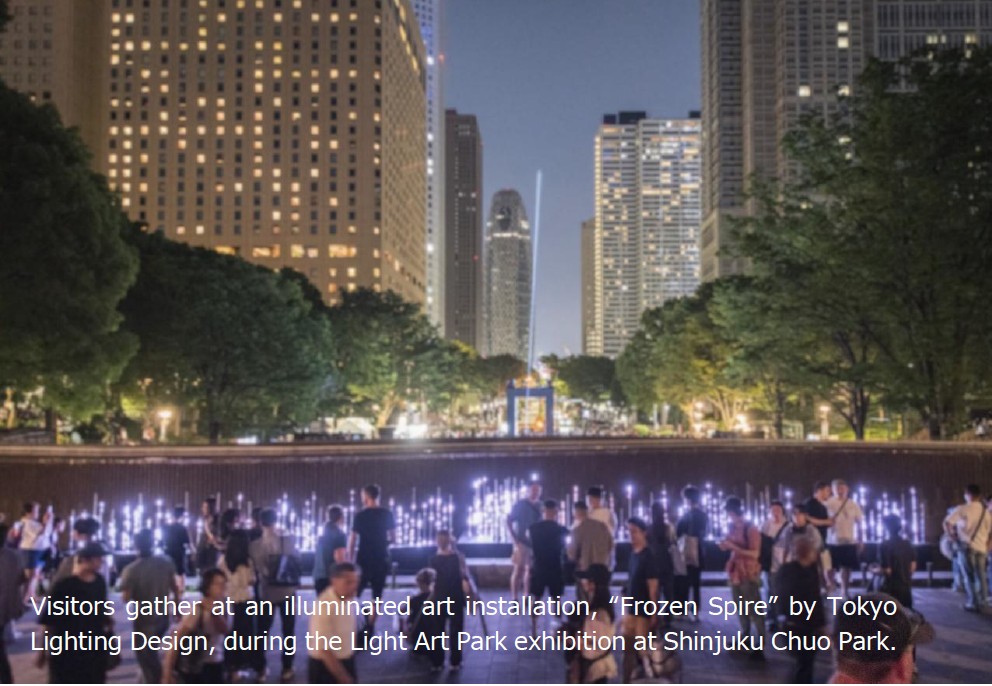
Visitors strolled between the TMG complex and Shinjuku Chuo Park through pedestrian overpasses and crossings over a four-lane street. For nine straight days, the undulating green park with a circumference of 1.1 kilometers served as an open-air museum of 12 illuminated art installations, concisely titled “Light Art Park.”
According to the official website, the project aimed to visualize—through light—the “invisible Tokyo,” encompassing the memories and emotions accumulated in the city, as well as the flow of the wind and the city’s atmosphere.
“GAIA,” a floating model of the Earth sized seven meters (23 feet) in diameter and created by British artist Luke Jerram, took center stage in the exhibition. The work was making its Japan debut after touring more than 30 countries and been seen by more than 8 million people since it was premiered in 2018.
“Embrace” by an Australian artist, who is only called by his alias of Beamhacker, invited visitors to join hands with human-shaped silhouettes that form an incomplete chain. When the gaps were filled by visitors, ripples of light spread outward in a chain reaction.
“Liquid Universe: Sōbō Chūfu — An Unclassifiable Entomologia of the Luminous Swarm” by Japanese artist Ochiai Yoichi was a four-meter light pillar that beams a stream of computer-generated imagery including fireflies, bioluminescent organisms and LED. “Visible TOWER” by Japanese unit “V_T” reflected the surrounding urban landscape and its visitors like a mirror during the day. At night, AI-generated collages of the city’s scenes appeared on an LED display.
“GAIA,” created on the basis of the U.S. space agency NASA’s imagery of the Earth’s surface, wowed people of all ages.
GAIA aimed to create a sense of the “Overview Effect,” its creator Jerram says in a message to TOKYO LIGHTS 2026. “Common features of the experience for astronauts are a feeling of awe for the planet, a profound understanding of the interconnection of all life, and a renewed sense of responsibility for taking care of the environment,” he explained, hoping that people in Tokyo will “come together and contemplate the Earth as if from space; an incredibly beautiful and precious place.”
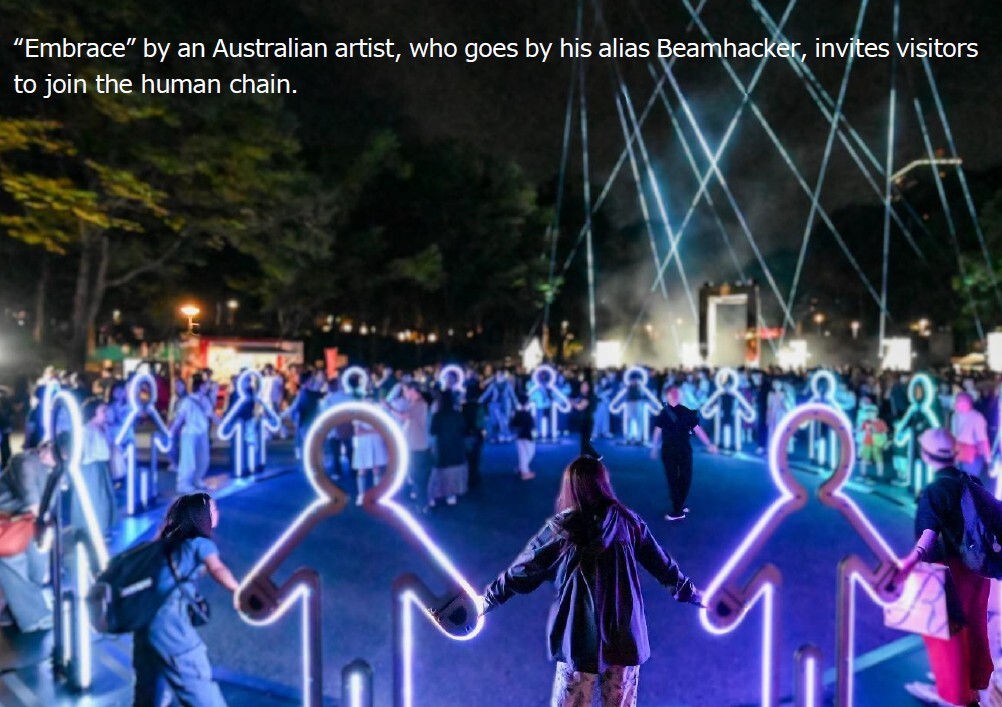
“It was a lot of fun, and lights and great photos,” said Steve Gottlieb, a real estate consultant in his late 50s visiting from New York City, after taking pictures of “Embrace.” “But the best light show is the moon,” he quipped, pointing upward to the second full moon of the month. “This is a nice park setting and it is very convenient and family friendly,” Gottlieb added.
Website: Light Art Park